

Communication 101
How good are you at communicating with yourself? When we hear the word communication, our initial thoughts go to examining how it is we do or do not interact with others. How many classes have you attended on the topic of communication? How many books have you been forced to read about how well it is you do or do not exchange words with others?
Communication is a daunting topic, and even when we think we are good at it, there is still more work to be done. Our focus on how well we engage others however often leaves little time to examine how it good we truly are at communication with our self.
Communication is the exchange of information. Effective communication entails choosing proper channels for communication, knowing who your target audience is for that communication. Communication skills are a must have if you are to succeed in multiple areas of your life. Your professional and personal relationships depend on your ability to send and receive information.
The capacity to establish a degree of common ground in understanding, cooperation and trust are essential elements in communication; Yet, how well do we take the time to do these things for ourselves?
Self-Awareness & Self-Care
Self-awareness is the ability to understand who you are and why it is you feel the way you feel and why it is you do the things that you do. Having self-awareness gives you an edge on life and grants you unprecedented freedom to change the things that are not working so well for you and to implement those things that will help to improve the way you handle everyday challenges.
Benefits Of Self-Care
Now that you are self-aware, what can you do to practice self-care? Self-care is all about taking care of the global being that is you. As the world continues to grow increasing ripe with anxiety and stress, it is no wonder that their physical health often finds itself at peril as self-care often falls to the bottom of the list of top priorities.
Proper self-care keeps our body and mind healthy. Exercise, adequate sleep, and healthy eating are just a small part of managing our self-care.
Other benefits of self-care include
Prevention of Overload and Burnout. Too much work does not translate to healthy self-care. Self-care encourages you to adjust your workload and schedule.
Decreases Stress Levels. Self-care can help to minimize the negative effects of stress. Too much stress can reduce the level at which your mind processes data. Proper self-care enables you to navigate difficult moments and days that elevate stress levels.
Focus. Self-care is essential to improving our ability to concentrate on the tasks at hand.
?Self-care provides us with an avenue for self-preservation and survival.?
Why Self-Awareness Is Important
Self-awareness has significance in our lives because it provides a baseline overview of who we are as an individual. It empowers us to not only see our weaknesses but to acknowledge our strengths. Next, self-awareness arms us with the ability set SMART (Specific Measurable Achievable Relevant Time-bound) goals.
How To Develop Self Awareness and Practice Self-Care
Developing self-awareness is doable. By having a deep understanding of your past and current self, you can begin to use these experiences to identify why you see things the way you do and how it is these experiences drive your actions.
Self-care is vital for your resilience and plays a critical role in formulating your self-talk behaviours. Take a look at the following options you have for developing self-awareness and practicing self-care.
What are the Things that Shape Your Early Life?
If you had to write the story of your life, what are the experiences you might include in that story? What are the events that live in your mind? Who are the people that may have influenced who you are today? How do you currently manage setbacks? How does your life affect how it is you communicate with yourself?
Daily Self Reflection Exercises
To create self-awareness, practice self-reflection each day. You can keep a journal, set aside time for prayer or do something that allows you to turn inward and examine your decisions and actions. You do not have to limit this reflection to just that day, but you can use it to explore various periods of time in your life. This practice will provide you with an extraordinary sense of inner peace and well-being.
Schedule Time for Self-Care
Schedule time for self-care by putting aside a couple of hours each week to manage all things that are solely you.
Get a Hobby
Do not minimize the importance of having a hobby. What you do in your spare time can significantly influence the way you communicate with yourself and potentially even enhance certain aspects of this practice by helping you get to know yourself that much more.
Disconnect and Unplug
There?s nothing better for your self-care than purposefully disconnecting from your technology. It?s an excellent way to spend quality, quiet time.
Make Time for Family and Friends
Sometimes, there?s no better self-care activity than spending time with family and friends. It?s the perfect opportunity for carving out time for necessary peace.
Learn to Say No
Self-care may leave with little choice but to say ?no.? when your schedule is too busy to make room for anything more. Taking on additional responsibilities is not always a good thing for your sanity. Pick a timetable for your self-care each week and stick with it. Say no to those things that will prevent you from achieving your self-care goals.
Eat Well
Nutrition is the fuel you need for mental wellness. Find the time to eat well even when you feel far too busy to prepare a meal.
Find Fitness
Get out and get fit. Keep it simple or amp up your fitness regimen by joining a gym. Take a walk, go for a swim or find a fitness class. Fitness and mental wellness go hand-in-hand and it might surprise you to find the multiple benefits exercise will deliver to you.
What Is Self-Talk
Your self-care practices are critical to the tone your inner voice takes in the form of self-talk. Self-talk is the inner voice within all of us that may serve as your biggest cheerleader or may act like your worst critic. It can drive how you feel or what it is you do.
This voice has conscious thought that is encased in subconscious biases, values, and beliefs. Self-talk can bring you a vast amount of confidence and self-awareness. It can talk you out of fear and encourage you to take a risk at times when you might otherwise prefer to turn and run.
Positive self-talk can have multiple advantages including:
- Improved body image
- Mental wellness
- Healthy self-esteem and the capacity to manage stress
- Reduced risk for self-harm
Self-Talk and Mental Wellness
Many people who have positive self-talk are thriving and successful beings. They can use their ambition, their beliefs, and past experiences to catapult them to only the best of possible outcomes.
On the opposite end of the spectrum, we have individuals who have to deal with anxiety or depression which can emerge in the face of dysfunctional self-talk. Dysfunctional self-talk is negative, mocking, destructive thoughts and voices that only see the negative in a given situation.
16 Tips For Developing Effective Self-Talk Techniques
So now you know that communication does not always happen between two or more people, but that it does on occasion start with you and self-talk. It is an interpersonal dialogue that transpires. How do we get better at it?
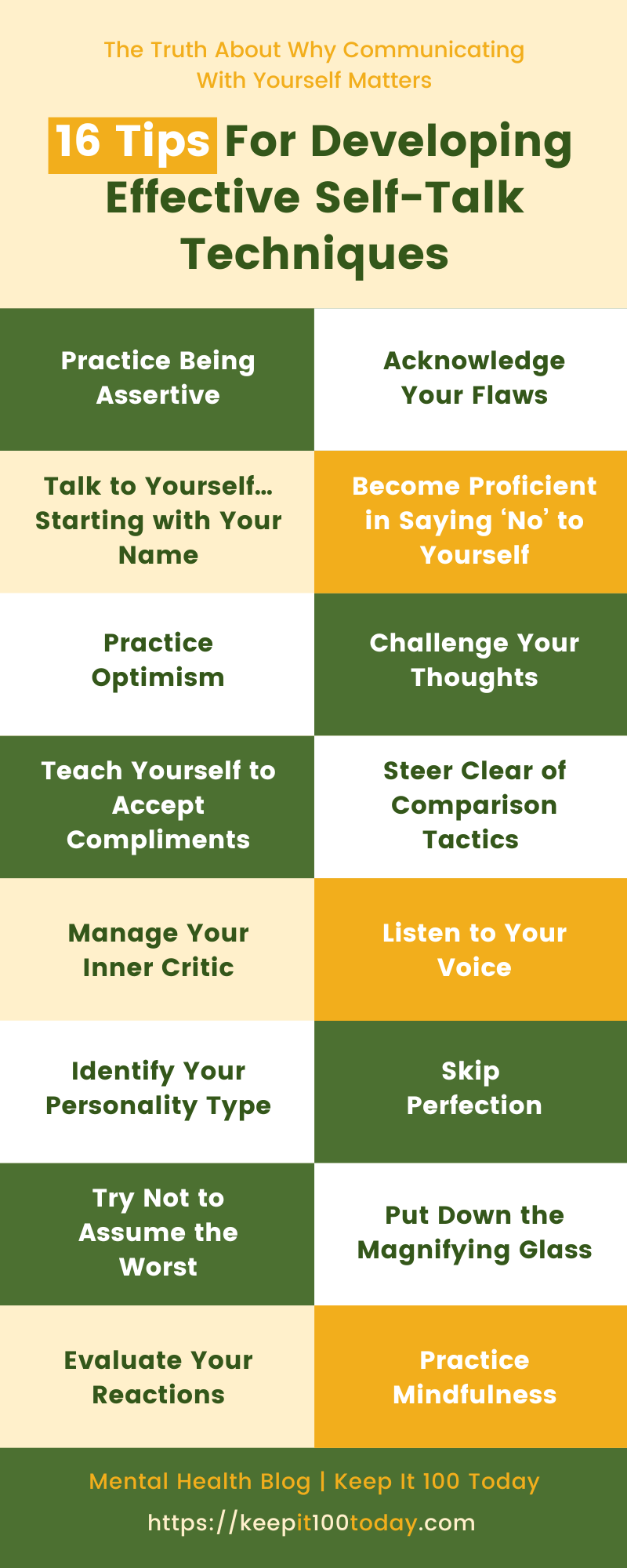
- Practice Being Assertive. We?re taught to be assertive about a given cause at home or in the workplace but what about being assertive with yourself? Self-assertiveness enables you to garner a bit of self-respect and self-advocacy. You can face your needs head-on and identify those situations that are not sustaining you.
- Acknowledge Your Flaws. Self-talk requires you to be aware of your flaws and accountable for not losing sight of those gaps. It does not mean that you should dwell in your weaknesses and ignore your strengths, but as your best advocate for self-care, you cannot allow them to set you up for failure.
- Talk to Yourself?Starting with Your Name. Practice saying your name aloud. After all, you are your own best friend here. Instead of using ?I,? self-talk insists you say your name whether motivating yourself to try something new or addressing something that you are doing that may not be so good for you.
- Become Proficient in Saying ?No? to Yourself. Saying ?yes? to yourself can open doors, but you also have to be just as good at telling yourself ?no.? Saying ?no? enables us to avoid the nasty pitfalls of bad decisions that can later negatively affect you.
- Practice Optimism. Aim for optimism. Work on seeing the glass as being half full as opposed to being half-empty in any situation.
- Challenge Your Thoughts. Examine the perspective you have at the moment about a particular situation or decision you might be ruminating over.
- Teach Yourself to Accept Compliments. Many of us are not good at receiving compliments. We get lost inside of our heads and are even quick to dismiss the praise. Rather than ignoring the compliment, hold onto it and treat it positively.
- Steer Clear of Comparison Tactics. Be careful to avoid comparing yourself to other people. This action will enable you to avoid labelling yourself as being inferior based on some crazy standard.
- Manage Your Inner Critic. While acknowledging those flaws is essential, you cannot allow negativity to cloud your internal channels of communication with yourself. Too much negativity can generate symptoms of anxiety or depression. If you make mistakes, do not chastise yourself for too long. Learn from your mistakes and look forward to how you might not repeat the same mistake twice or for a third time. Practice self-compassion. Self-compassion will enable you to balance monitoring your gaps.
- Listen to Your Voice. This next tip may seem like ?no-brainer? action, but it is worth stating nonetheless. Learn to listen to your voice. Pay attention to the vibe it is giving off and what is triggering the positive or negative tones.
- Identify Your Personality Type and Learn to Communicate with You. How many personality tests have you taken in school or at work just learn more about who you are and how it is you should communicate with others. Use this knowledge also to define how it is you should communicate with yourself to promote self-care.
- Skip Perfection. Do not allow the belief that you must be successful, competent or fail-proof in all things. It?s true; no one is perfect. Should only compete with yourself by aiming to exceed your personal benchmark.
- Try Not to Assume the Worst. You may be up for a challenging project that feels like it is above your qualifications, but it does not mean you should assume that only the worst will occur. Have the courage to envision success.
- Put Down the Magnifying Glass. Do what you can to not magnify the importance of an outcome. Good or bad, you may find yourself overwhelmed by the result, triggering stress.
- Evaluate Your Reactions. As you listen to your inner voice, examine your reaction to various events. Evaluate whether or not you are overreacting or underreacting to things. Are you too hard on yourself? Are you truthful? Do you have realistic expectations for yourself?
- Practice Mindfulness. Mindfulness is the art of being fully present in the here and now. You are in complete control and aware of where you are and what it is you are doing. Many people achieve mindfulness through the practice of meditation. Meditation allows you to clear your mind, ditch the distraction of judgment or failings and experience the moment.
Putting It All Together
There are a lot of fantastic tips embedded in this report for improving your self-care so that you can master self-talk but how can you put it all together? Remember that your self-care is essential to self-talk. If anything within the framework of your self-care is out of sync, it will have a direct effect on your self-talk.
With proper self-care, positive self-talk can thrive. Positive self-talk is that which is affirming and supportive. Again, it is the voice within that cheers you on to take a chance or motivates you to do great things in the world. Just when you are ready to give up, this voice tells you that you can do it.
Without proper self-care, negative self-talk can emerge. That voice replays everything bad that may have happened in a single day, month, year or at some other point in your life. Negative self-talk leaves you spinning your wheels without any real solution to a problem. It can trigger anxiety and depression.
You should treat yourself as a friend. Rather than disparaging yourself at every turn through the use of negative self-talk, have all the compassion in the world for yourself. Controlling those inner thoughts is the key to the power of your self-talk.
Final Thoughts
In summary, self-care is a critical value in self-talk or self-communication. It requires us to examine our internal thoughts and behaviours, and why it is, we do or do not adequately advocate on our behalf.
Self-talk can be destructive if not managed well or without seeking help. We must prioritize ourselves, look for cues and adjust as necessary to prevent our negative thoughts from overtaking our ability to thrive and succeed. We all have the power to shape our self-talk and use it to motivate you during even the most difficult of times and challenges.
Positive self-talk has the power to improve your performance, raise your confidence level and boost your mood. If used properly, self-talk can improve your life on several levels.